In brief
Google DeepMind describes native audio and real-time steering in Genie 4. Its own limitations make object persistence the first test I would run, before treating a generated scene as a reliable simulator.
Originally published on Jack Gross.

Analysis and proposed test, not a product test
What the launch actually offers
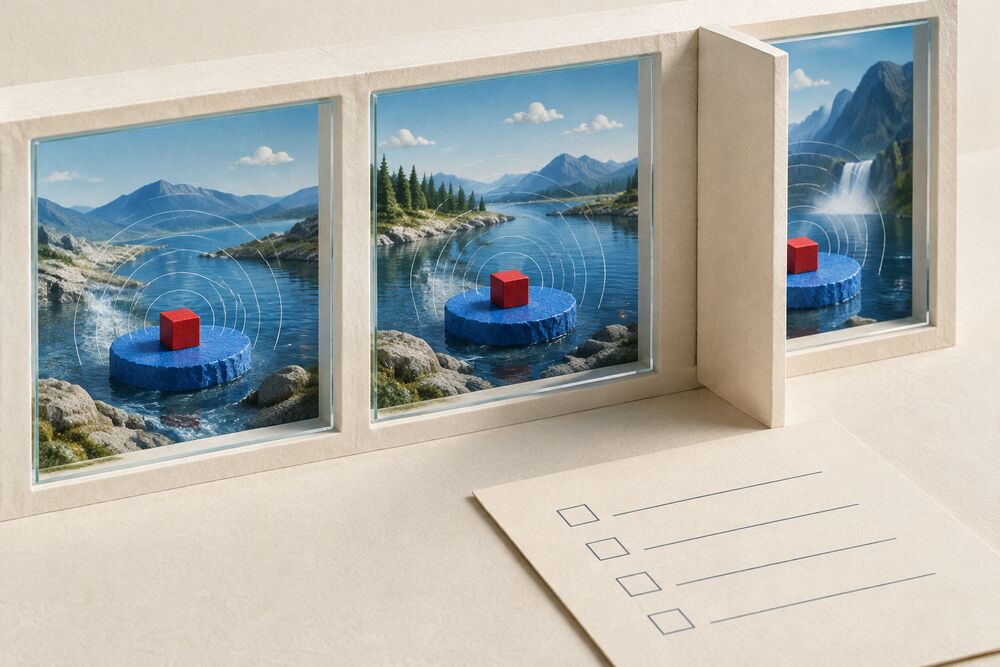
A red cube disappears behind a wall. When the camera returns, is it still the same cube, in the same place? That is my proposed evaluation question, not a report of a Genie 4 test. I read Google DeepMind's October 27 announcement and its explicit limitations. The useful tension is between a world that looks convincing and one whose state stays dependable.
Google describes Genie 4 as a real-time world model with native ambient audio, music and interactive dialogue. Text can steer weather, camera position or the objects and people in a scene. The launch says Gemini Omni helps anchor appearance and behavior, while other Gemini models help maintain coherence. These are vendor descriptions, not measurements I reproduced.
The loop contains two kinds of work
The detailed post describes Gemini 3.8 Flash observing generated frames, breaking goals into steps and reviewing progress as Genie 4 renders. It also describes experiments combining Gemini 4 Argon, Genie 4 and robotics research. I read that as a separation between planning and sensory generation: a planner can request the next event, but the resulting frame still has to be checked.
A plan saying that a cube remained on a table is not itself evidence that the generated scene preserved it. The same applies to sound: a plausible impact noise does not establish the position, timing or identity of the object that supposedly produced it. My analysis is that these checks belong in the evaluation record rather than being inferred from a polished demo.
The vendor names the weak points
DeepMind says short sessions can remain coherent, but visual details and object permanence can drift as sessions grow, after complex prompt edits or during navigation. It lists complex physical interactions, audio accuracy, legible text, spatial accuracy and long-term consistency as active research areas. That is a direct reason to keep physical-validity claims narrower than visual-realism claims.
Availability is limited too. Genie 4 is a research preview for trusted testers. Google says access is coming to Google AI Ultra subscribers in Project Genie and early access partners in the Gemini API and AI Studio. Coming soon is not general API availability. The pages checked do not establish an open price, a public quota or a guaranteed rollout date.
A small evaluation I would prepare
For a permitted evaluation, I would choose one object, record its initial position and appearance, hide it behind an occluder, move the camera and then reveal it. A second pass would change weather without asking to change the object. A third would examine whether a visible contact and its sound stay aligned. These are proposed checks, not tests I ran on Genie 4.
Record the prompt sequence, model/access version when exposed, elapsed time and frames used for each judgment. Mark an obscured or ambiguous observation unknown. Do not count it as a pass. Repeating the sequence across sessions would reveal variability that a single selected recording cannot show. The accompanying Python example only summarizes manually entered judgments; its example rows are fictional.
Illustrative code only; not executed against the product.
from collections import Counter
# Fictional, manually entered observations. Not Genie output.
checks = ["pass", "fail", "unknown", "pass"]
counts = Counter(checks)
assert set(counts) <= {"pass", "fail", "unknown"}
print(dict(counts))
# {'pass': 2, 'fail': 1, 'unknown': 1}
What I would use it for first
The launch describes tester work in creative previsualization, explorable prototypes and scenario generation. Those are sensible starting points for a tool whose consistency is still being researched. A filmmaker can evaluate a draft by whether it helps choose a camera move. A robotics test needs a separately defined standard for the state transitions it relies on. I would not let one acceptance criterion stand in for the other.
DeepMind says generated video and audio include SynthID watermarking. That is a provenance measure; it does not validate physics. My next step would be a documented continuity evaluation when access is available, with failures and unknowns retained alongside successful scenes.
Sources checked October 28, 2026
- https://blog.google/innovation-and-ai/models-and-research/google-deepmind/introducing-genie-4/
- https://deepmind.google/blog/genie-4-a-new-generation-of-world-simulation/