Z.ai & GLM 5.2: The Agentic Intelligence Frontier
🤖 Agentic Intelligence, Measured
A 1M-token, MIT-licensed open model redefining long-horizon autonomous work — every number in this piece is pulled from live data, not marketing copy.
Executive Summary
For months now, the conversation around AI has shifted from "which model chats the best?" to "which model can you actually hand a job and trust it to finish?" That's the agentic shift — systems that reason, plan, and execute long-horizon tasks on their own. And that shift puts a very specific demand on models: hold context at scale, and act reliably without a human babysitting every step.
Z.ai's flagship GLM-5.2 is aimed squarely at that problem: a solid 1M-token context, flexible-effort coding, and a new sparse-attention architecture — all under a fully open MIT license.
The headline: GLM-5.2 is already the most-adopted GLM on HuggingFace with 2.52M downloads and 4,932 likes — and on agentic/coding benchmarks it leaps ahead of its predecessor GLM-5.1 (e.g. Terminal-Bench 2.1: 81.0 vs 63.5, FrontierSWE: 74.4 vs 30.5).
🎉 Learn About Z.ai Coding Plans
The Model: GLM-5.2 by the Numbers
Z.ai positioned GLM-5.2 as its flagship for long-horizon tasks, and the naming makes the lineage clear — it builds directly on the GLM-5 line, whose slogan is literally "From Vibe Coding to Agentic Engineering." Here's what the official model card actually lists:
- Solid 1M-token context — holds up over long agentic sessions, no context collapse.
- Flexible thinking effort — you pick the effort level, trading latency against depth per task.
- IndexShare architecture (arXiv:2603.12201) — one indexer shared across every four sparse attention layers, cutting per-token FLOPs by 2.9× at 1M context.
- Improved MTP layer for speculative decoding — up to +20% longer token acceptance.
- Pure open — MIT license, no regional limits.
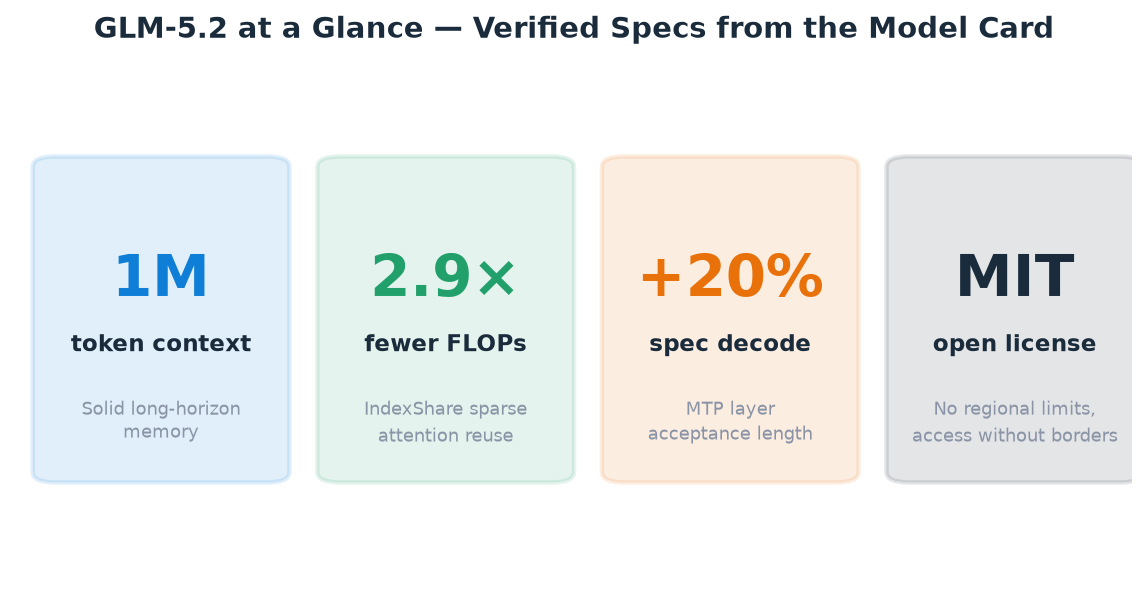
Verified specs from the official GLM-5.2 model card (HuggingFace).
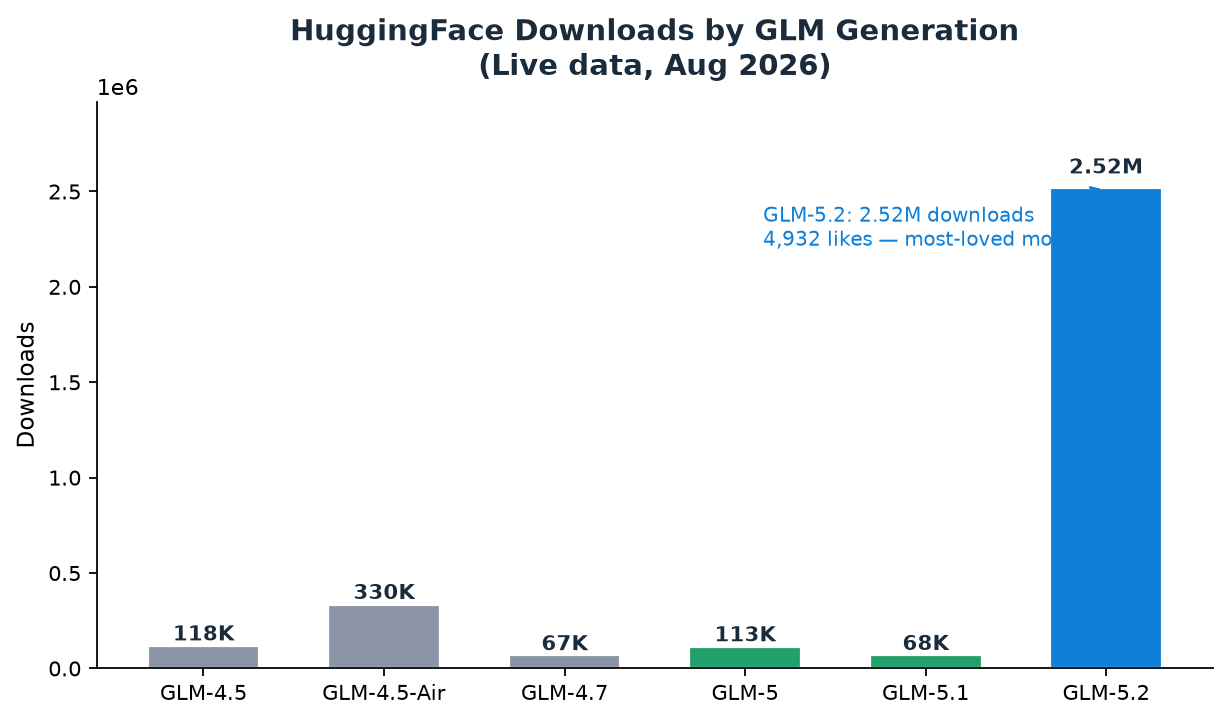
Live HuggingFace download counts across GLM generations — GLM-5.2 is the outlier.
Benchmarks: Where GLM-5.2 Wins
Full disclosure: everything below is from the official GLM-5.2 model card — self-reported, standard harnesses. I'm not treating it as gospel, but the trend across independent suites is consistent. On agentic coding and tool-use, GLM-5.2 leads the GLM line and trades blows with frontier closed models:
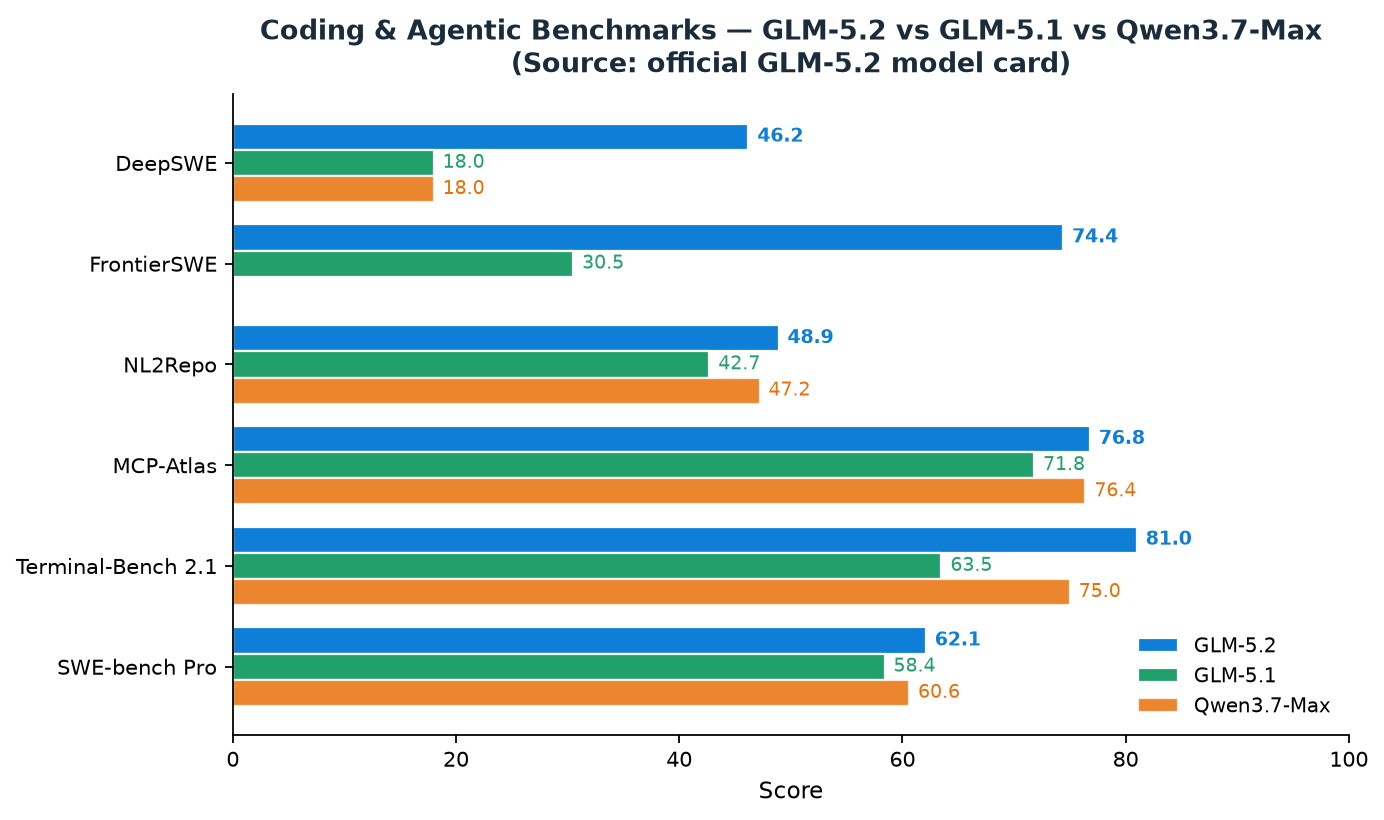
Coding & agentic benchmarks — GLM-5.2 vs GLM-5.1 vs Qwen3.7-Max (official model card).
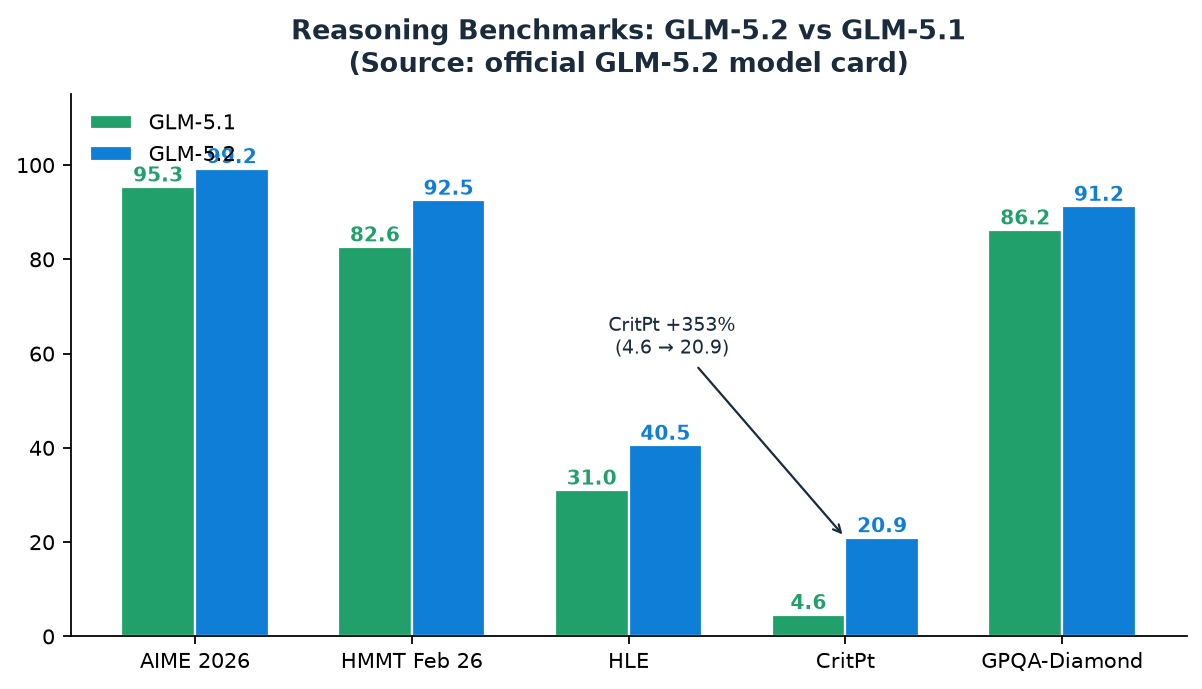
Reasoning benchmarks: the biggest jumps are in critical-point reasoning (CritPt +353%) and agentic math.
Takeaway: The largest gains are exactly where "agentic intelligence" lives — terminal operation (81.0), MCP tool-use (76.8), and frontier repo-level software engineering (74.4). This is a model engineered for agents, not just chat.
The Ecosystem: From ChatGLM to GLM-5.2
Z.ai didn't come out of nowhere — its GitHub org is one of the most-starred open AI orgs out there. Pulled live from the zai-org GitHub API:
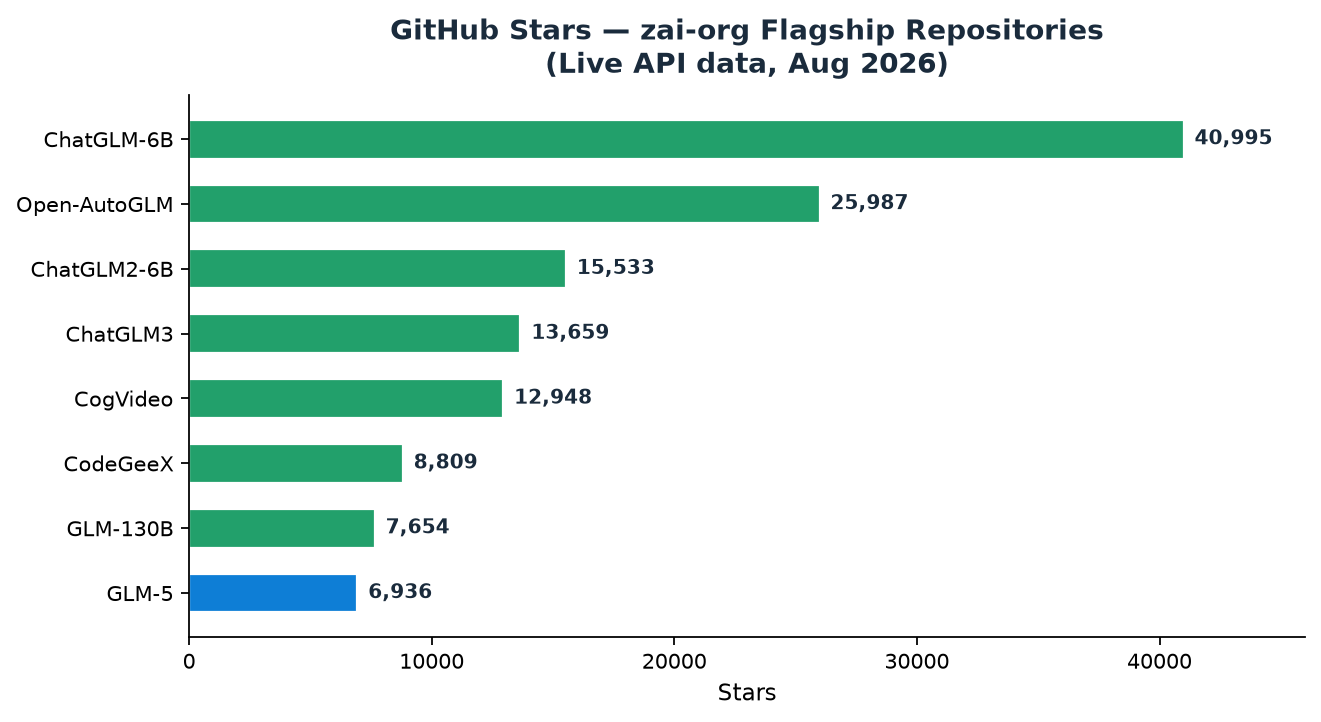
Live GitHub stars across zai-org flagship repositories — 8 repos above 6,000 stars.
GLM-5.2 also fits into a mature toolchain: it serves through SGLang, vLLM, Transformers, KTransformers, Unsloth and Ascend-NPU stacks, with OpenAI-compatible APIs on the Z.ai platform — the same API surface agent frameworks like Hermes Agent already speak (I've routed glm-5.2 as a live endpoint in mine).
ZCode IDE: GLM-5.2's Natural Home
The model is only half the story. The other half is the tool you run it in — and ZCode is where GLM-5.2 gets to show off. ZCode is an AI-native IDE built around the GLM line, and it's the first mainstream editor I've seen take subagent composition seriously instead of treating it like a party trick.
What makes ZCode different
- Cross-device continuity — your agent's context follows you from desktop to laptop to remote box without losing the thread.
- Subagent composition — instead of one model doing everything, ZCode spins up focused subagents: one reads the codebase, one plans the refactor, one writes the tests, one drafts the PR. You orchestrate, it executes.
- GLM-5.2 native — it's the same model family this article is about, so the 1M-token context and flexible effort levels are first-class, not bolted on.
- Built for long-horizon tasks — multi-step refactors, repo-wide changes, agent workflows that run while you're away.
Why it matters: The "10x developers" of 2026 aren't prompting one tool — they're orchestrating agent teams. ZCode's subagent model is the closest thing I've used to that workflow out of the box, and it's built on the exact architecture this article is about.
Why It Matters for Agentic Intelligence
- Long-horizon autonomy: 1M context means an agent can hold an entire repo, a long conversation, and a multi-step plan in memory at once.
- Cost-aware thinking: effort levels let you pay for depth only when you need it — a real lever in production.
- Open, not walled: MIT license + open weights means your agent stack isn't hostage to one vendor.
- Community momentum: 2.52M HF downloads and 4,900+ likes aren't vanity metrics — people are actually running this thing.
Conclusion
GLM-5.2 is more than a spec-sheet bump. It's a deliberate push toward agentic engineering: open weights, long context, tool-native benchmarks, and an architecture that makes 1M-token inference 2.9× cheaper in FLOPs. If you're building autonomous systems, that combination — capability, openness, efficiency — is hard to beat in the open-model world right now.
If you're building agents in 2026, GLM-5.2 is the open model to start from.
🔭 1M-token context for long-horizon autonomy
📈 Live adoption: 2.52M HF downloads, 4,932 likes
⚡ 2.9× FLOP reduction via IndexShare at 1M context
🔓 MIT open license — no vendor lock-in
Data sources: HuggingFace model API (zai-org/GLM-5.2 downloads & likes, accessed Aug 2026), GitHub API (zai-org repositories), official GLM-5.2 model card benchmark table. Benchmark figures are as reported by Z.ai; independent reproduction may vary. This article is informational and not investment advice.